hardware
Ultra‑Budget PSU 2026: MSI MAG A550BN vs Thermaltake Smart 600W vs Apevia SP700 — Are Extra Watts a Lie?
Ultra-Budget PSU Trap: Big Watts, Cheap Price – What's the Catch? Let's dive into this topic
- 7 min read
Most buyers at the bottom of the market still believe "more watts = better". An unknown 700W unit under $45? Sounds perfect. We compared three entry-level power supplies – MSI MAG A550BN, Thermaltake Smart 600W, and Apevia ATX‑SP700 – and discovered that not every watt is created equal. This is the reality of entry-level power supplies in 2026: marketing tricks, missing protections, and one clear winner for those who refuse to gamble with their components.
Info
PSU buying guide
The +12V rail is where almost all modern PC power is drawn. A "700W" unit with a weak +12V rail is really a 500W PSU in disguise — and that's before we talk about component quality.
80 Plus White is barely enough — Bronze is safer White units often lack crucial protections and run hotter, which shortens their lifespan.
What to check in a budget PSU before you buy:
- No Active PFC - Without APFC, a PSU wastes energy and may trip on unstable mains voltage.
- Missing protections (OTP, OCP) - Over‑temperature and over‑current protections are often sacrificed to cut costs.
- Sleeve‑bearing fans - They get loud fast and can seize up after a year of heavy use.
Three rules to avoid a PSU fire:
- Always check the +12V rail amperage, not just the model number
- Choose a unit with full protections (OTP, OCP) over raw wattage — safety beats a bigger number on the box
- If a unit feels suspiciously light, the heatsinks are probably undersized
How to safely install a budget PSU:
Even a cheap PSU needs proper mounting to avoid short circuits.
PSU Install TutorialPSU Comparison: Key Specs & Features
| Protections | PCIe | |||||
|---|---|---|---|---|---|---|
MSI MAG A550BN 550W 80 Plus Bronze Best pick | 550 W | 80 Plus Bronze | 45.8 A | OVP, OPP, SCP, UVP, OCP, OTP | 2x 6+2 pin | Check price on Amazon |
Apevia ATX-SP700 700W | 700 W | 80 Plus White | 45 A | OVP, SCP, OPP | 2x 6+2 pin | Check price on Amazon |
Thermaltake Smart 600W ATX 80 Plus White | 600 W | 80 Plus White | 42 A | OVP, SCP, OPP | 2x 6+2 pin | Check price on Amazon |
MSI MAG A550BN 550W 80 Plus Bronze Best pick
550 W80 Plus Bronze45.8 A +12VPCIe: 2x 6+2 pinProtections: OVP, OPP, SCP, UVP, OCP, OTPApevia ATX-SP700 700W
700 W80 Plus White45 A +12VPCIe: 2x 6+2 pinProtections: OVP, SCP, OPPThermaltake Smart 600W ATX 80 Plus White
600 W80 Plus White42 A +12VPCIe: 2x 6+2 pinProtections: OVP, SCP, OPP
* As an Amazon Associate I earn from qualifying purchases.
MSI MAG A550BN: The Only Safe Bet
* As an Amazon Associate I earn from qualifying purchases.
- 1
Genuine 550W with full protections — the one you can actually trust
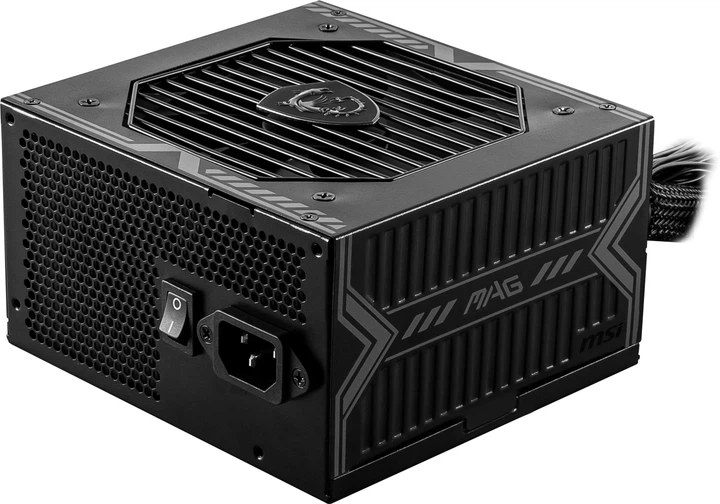
The MSI MAG A550BN is the only unit in this group with a complete set of protections (including OTP and OCP) and a modern DC‑DC platform. Its +12V rail delivers the full 550W, and ripple stays well within ATX spec. The HDB fan is quiet up to 60% load, and the long support period signals that MSI stands behind this product. It's the cheapest PSU we'd feel safe using with a discrete GPU. For anyone building a budget gaming PC, this is the baseline — not the competition.
- 2
Built to last without frills
Yes, it's non‑modular, but the cables are decently long and the flat design helps with routing. It lacks a semi‑fanless mode, though you'll never hear it over a stock CPU cooler. The biggest difference from the cheaper units? It won't kill your components when the room temperature goes up. If your budget is extremely tight, skip the RGB fans and put that money here.
Pros and Cons: MSI MAG A550BN
Pros
Full protection suite (OTP, OCP, UVP, OVP, SCP, OPP)
Honest 550W on a clean DC‑DC platform
Quiet HDB fan
Low ripple and stable voltages
Cons
Non‑modular
550W limit means no extreme GPU upgrades
Flat cables still need careful routing
Conclusion
MSI MAG A550BN is the recommended ultra‑budget PSU for gaming. Full protections, stable voltages, and a quiet fan make it the baseline for safe budget building.Thermaltake Smart 600W: The Illusion of Power
* As an Amazon Associate I earn from qualifying purchases.
- 1
600W on the box, but only 504W usable on +12V
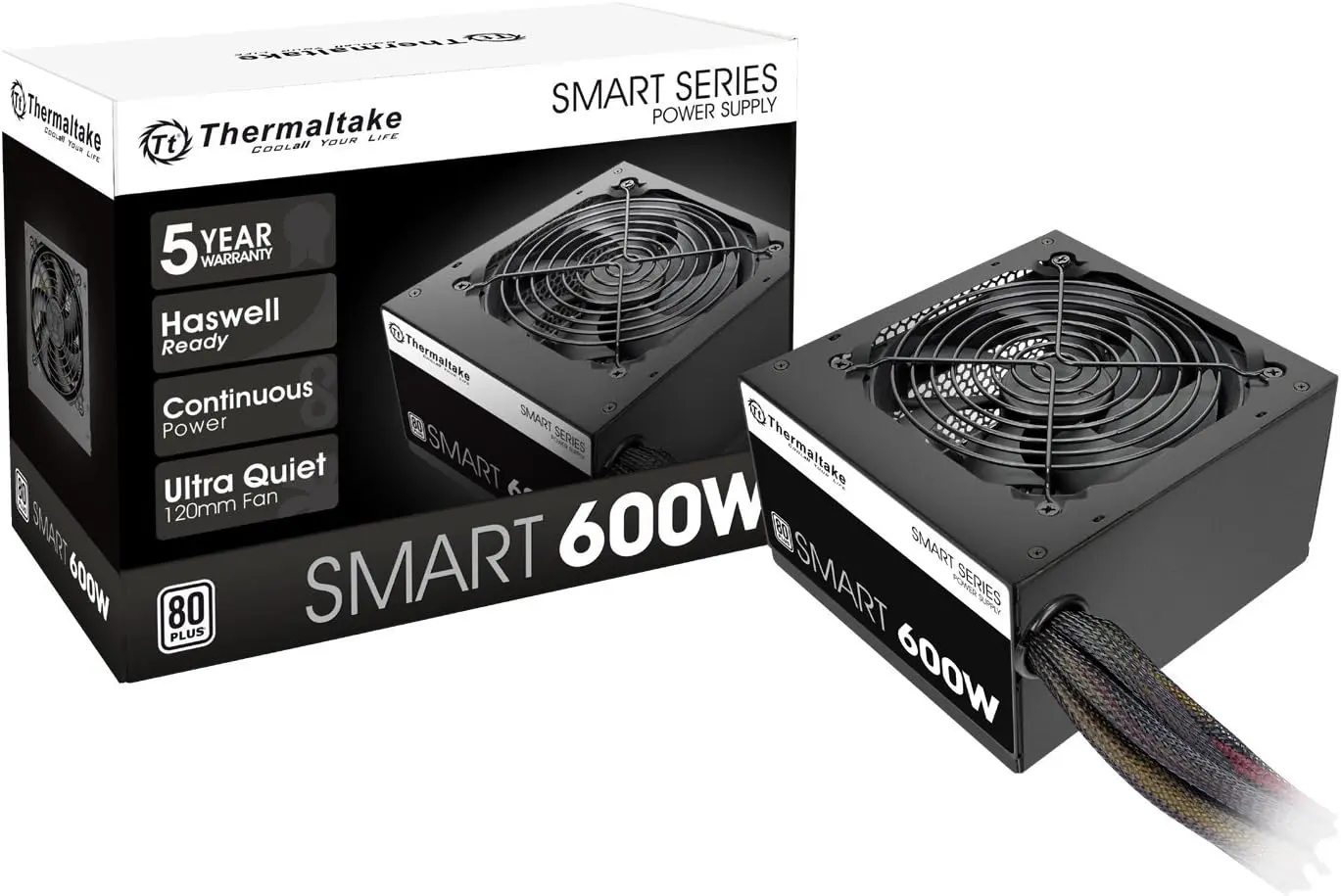
The Thermaltake Smart 600W is the bestseller in the ultra‑cheap category, but its +12V rail is rated at just 42A (504W). That means it can barely deliver more usable power than the 550W MSI unit, despite the bigger number on the box. It uses an outdated group‑regulated design, so cross‑loading (heavy GPU, idle CPU) causes voltage swings that can destabilize your system. Protections are bare‑bones: no OTP, no OCP on minor rails. For a PC that never exceeds 400W total draw, it works — but you're putting your trust in a unit built down to a price, not up to a standard.
- 2
Loud and hot when pushed
The sleeve‑bearing fan is already noisy at 50% load, and efficiency barely clears 80%, meaning the rest is turned into heat inside your case. The low weight hints at small heatsinks. Forum reports confirm this PSU frequently fails after a year in a gaming rig. It's acceptable for an office machine or a very light HTPC, but for any gaming GPU, the MSI is far safer. In the world of ultra‑budget PSUs, the Smart 600W is the most popular example of "you get what you (don't) pay for."
Pros and Cons: Thermaltake Smart 600W
Pros
Lowest price for a known brand
600W on the box (but not really)
Two PCIe 6+2 pin connectors
Cons
+12V rail only delivers 504W
Group‑regulated — poor cross‑load performance
No OTP, no OCP on minor rails
Sleeve‑bearing fan gets loud under load
Low efficiency (barely 80% at full load)
Conclusion
The Smart 600W sells on brand trust but comes with a weak +12V rail and no thermal protection. Fine for office PCs, but a risky choice beside a dedicated GPU.Apevia ATX-SP700: The Risky 700W Promise
* As an Amazon Associate I earn from qualifying purchases.
- 1
One of the cheapest 700W labels — but it's really a 540W unit with big compromises
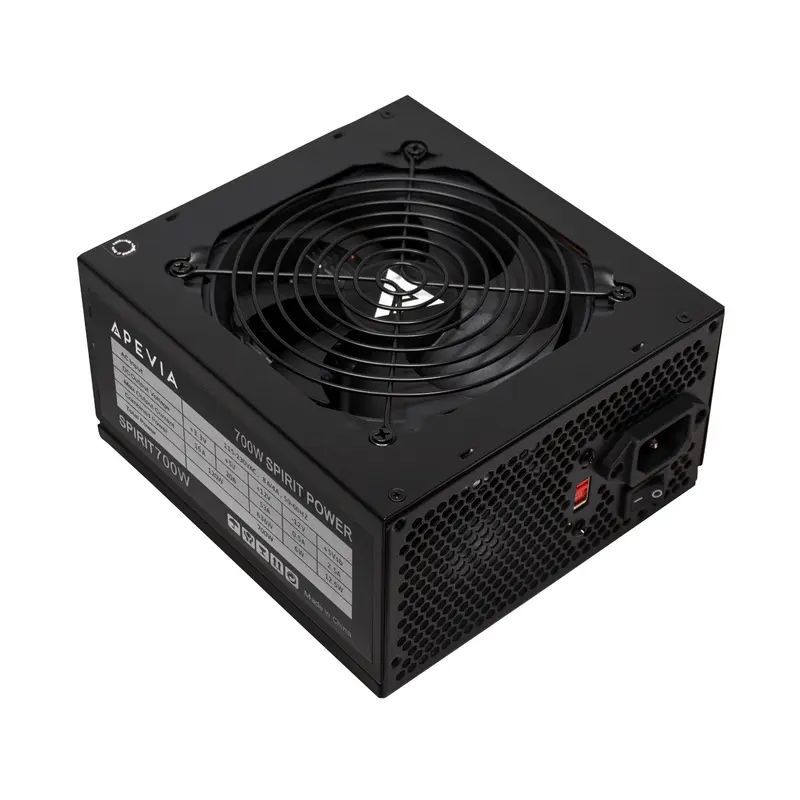
Apevia pushes the wattage number even higher (700W), yet its +12V rail maxes out at 540W — still not true 700W capability. The internal design is ancient group‑regulated, and the lack of active PFC means efficiency drops drastically outside 230V regions. Protections are minimal (no OCP, no UVP, no OTP), and the sleeve‑bearing fan becomes obtrusive above 60% load. At this price, it's tempting for a budget builder who sees "700W" and imagines an upgrade path, but this unit is a house of cards under sustained gaming loads.
- 2
Only for temporary or non‑critical use
Short, stiff cables make installation a chore. Voltage ripple can exceed safe limits when both CPU and GPU are stressed. For a desk PC that only runs web browsing, it's okay. For anything with a graphics card that has a power connector — stay far away. This PSU exists solely to win the "highest wattage for the lowest price" race, and the corners cut are dangerous.
Pros and Cons: Apevia ATX-SP700
Pros
One of the cheapest PSUs with 700W on the label
Two PCIe 6+2 pin connectors
Cons
+12V rail is really 540W
Group regulation — dangerous voltage swings
Missing OTP, OCP, UVP
Extremely loud at >60% load
Short, stiff cables
Conclusion
Apevia SP700 is the poster child for "too good to be true." Its 700W label hides a weak platform and missing safety nets. Not recommended for any gaming rig.Verdict
The only ultra‑budget PSU worth your money MSI MAG A550BN
MSI MAG A550BN is the clear winner — not because it's perfect, but because it's the only one that respects your components. Full protections and honest wattage make it the minimum we'd put in a gaming PC.
Why the others fall short:
-
Thermaltake Smart 600W is a textbook example of brand leverage on a weak platform. It works for office PCs but misleads gamers with its 600W badge when the +12V rail delivers only 504W.
-
Apevia ATX‑SP700 is a gamble dressed up as a 700W PSU. The missing protections and group regulation make it unsuitable for any system with a dedicated GPU. It exists only to win the "cheapest highest‑wattage" marketing game.
Frequently Asked Questions
Only if the +12V rail delivers enough current. The Thermaltake Smart 600W provides 42A (504W) on +12V, which is theoretically enough for a 130‑165W GPU plus a 65W CPU. However, the lack of OTP and weak ripple filtering make it risky for daily gaming. The MSI A550BN with its 45.8A and full protections is a much safer choice even though it's rated 50W lower.
Group‑regulated PSUs (Thermaltake Smart, Apevia SP700) tie the +12V and +5V rails together. When you load the GPU heavily and the CPU idles, the +5V rises and +12V drops, potentially causing instability. DC‑DC units (MSI) independently convert voltage, so the rails stay stable even under uneven loads. For modern systems, DC‑DC is vastly superior.
It's a cost‑saving measure. A thermal sensor and shutdown circuit add a few cents per unit, but in the race to the lowest price, these protections are often the first to go. Without OTP, a fan failure can lead to a meltdown instead of a safe shutdown.
Not recommended. The SP700 uses a sleeve‑bearing fan that degrades quickly under constant use. Its group‑regulated design is also inefficient at low loads. For a 24/7 system, spend a bit more on a unit with a HDB or rifle‑bearing fan and active PFC.
It's not a firebomb, but it's built for office PCs, not gaming. If you pair it with a GPU that stays under 120W and your room is cool, it can survive. But you're betting against heat and time — two enemies this PSU isn't equipped to fight. For a small price difference, the MSI buys you significantly more safety.
MSI MAG A550BN. It's the cheapest unit that still includes a full set of protections and a modern DC‑DC platform — meaning it won't put your components at risk when the room gets warm. If you absolutely cannot stretch your budget that far and only need an office PC or a very light home theater build, the Thermaltake Smart 600W can work — but disable any overclocking, pair it only with low‑power components, and keep it dust‑free. For anything with a dedicated gaming GPU, the MSI is the floor — don't go below it.
Yes. The MSI MAG A650BN and A750BN use the same modern DC‑DC platform and full protections as the A550BN, just with a higher wattage ceiling. The A650BN delivers 54A on +12V (648W) and the A750BN delivers 62.5A (750W). They’re solid choices for mid‑range builds with an RTX 5060 Ti / RX 7700 XT or a power‑hungry CPU. In this price segment, they’re still the safest bet when 550W isn’t enough.
You May Also Like
- Best Ultra-Budget Gaming Mousepads Under $5 for CS2 & Valorant (2026)
- Best Ultra-Budget Rapid Trigger Keyboards Under $40 for CS2 & Valorant (2026)
- Best Ultra-Budget LGA1700 Motherboards Under $80: ASRock H610M vs GIGABYTE S2H vs MSI H610M
- How to Set Up 4:3 Stretched in CS2: No Black Bars + FPS Boost (NVIDIA, AMD & Intel)
- Best Ultra-Budget 240Hz Monitors Under $120 for CS2 & Valorant (2026)